Advancing AI Literacy
Across the HBCU Network
ASCEND-AI is a four-year, $4 million FIPSE-funded initiative designed to build sustainable AI literacy capacity at Historically Black Colleges and Universities through faculty development, student programming, and inter-institutional collaboration.
Advancing Student and Collaborative Educator Networks for Digital AI
A collaborative initiative among Howard University (lead), Bowie State University (co-lead), ad a Local Educational Agency partner to prepare faculty, postsecondary students, and secondary educators for an AI-integrated workforce.
Advancing Student and Collaborative Educator Networks for Digital AI
A collaborative initiative among Howard University (lead), Bowie State University (co-lead), ad a Local Educational Agency partner to prepare faculty, postsecondary students, and secondary educators for an AI-integrated workforce.
Reciprocal Capacity Building
Bridging the Gap in AI Literacy & Research
The ASCEND-AI initiative operationalizes a Reciprocal Capacity Building Framework grounded in communities of practice theory (Wenger, 1998), constructivist learning principles, and evidence-based instructional design.
Through this framework, Howard University and Bowie State University leverage complementary institutional strengths, including Howard’s HBCU-UP Targeted Infusion Project infrastructure and Bowie State’s established Faculty Learning Community model with 44 active participants, to build interconnected AI Competent Communities. These communities serve as the primary mechanism for scaling AI literacy across disciplines, institutions, and educational levels.
400+
Students Served Annually
50+
Faculty Members

Reciprocal Capacity Building
Bridging the Gap in AI Literacy & Research
The ASCEND-AI initiative operationalizes a Reciprocal Capacity Building Framework grounded in communities of practice theory (Wenger, 1998), constructivist learning principles, and evidence-based instructional design.
Through this framework, Howard University and Bowie State University leverage complementary institutional strengths, including Howard’s HBCU-UP Targeted Infusion Project infrastructure and Bowie State’s established Faculty Learning Community model with 44 active participants, to build interconnected AI Competent Communities. These communities serve as the primary mechanism for scaling AI literacy across disciplines, institutions, and educational levels.
400+
Students Served Annually
50+
Faculty Members
Strategic Objectives
Three Pillars of Transformation

AI Literacy and Workforce Development
Developing five core AI literacy modules, covering fundamental concepts, responsible use and academic integrity, detection of AI-generated content, discipline-specific applications, and AI Innovation, to equip 50+ faculty annually and provide AI literacy experiences to 400+ students through certificate programs, summer bridge initiatives, and dual enrollment courses.

Sustainable Institutional Capacity
Establishing sustainable institutional infrastructure, including Faculty Learning Communities, Canvas LMS implementation, enterprise AI platforms and comprehensive assessment frameworks, to ensure AI literacy capacity persists beyond the grant period.

Collaborative Ecosystem
Building a collaborative ecosystem across postsecondary and secondary education through the Howard–Bowie State– Local Educational Agency partnership, including tri-annual collaborative workshops, AI Use Competitions, and a postsecondary-to-secondary pipeline that prepares the next generation of ethically grounded AI practitioners.
Strategic Objectives
Three Pillars of Transformation
AI Literacy and Workforce Development
Developing five core AI literacy modules, covering fundamental concepts, responsible use and academic integrity, detection of AI-generated content, discipline-specific applications, and AI Innovation, to equip 50+ faculty annually and provide AI literacy experiences to 400+ students through certificate programs, summer bridge initiatives, and dual enrollment courses.
Sustainable Institutional Capacity
Establishing sustainable institutional infrastructure, including Faculty Learning Communities, Canvas LMS implementation, enterprise AI platforms and comprehensive assessment frameworks, to ensure AI literacy capacity persists beyond the grant period.
Collaborative Ecosystem
Building a collaborative ecosystem across postsecondary and secondary education through the Howard–Bowie State– Local Educational Agency partnership, including tri-annual collaborative workshops, AI Use Competitions, and a postsecondary-to-secondary pipeline that prepares the next generation of ethically grounded AI practitioners.
Mark Your Calendar
Upcoming Events
Mark Your Calendar
Upcoming Events
Mark Your Calendar
Upcoming Events
Faculty Development

Feb 15, 2026
10:00 AM
-
3:00 PM
Tri-Annual Collaborative Workshops
Joint workshops bringing together FLC members to share research and pedagogical strategies
Learn more
Symposium
Apr 23, 2026
8:30 AM
-
3:30 PM
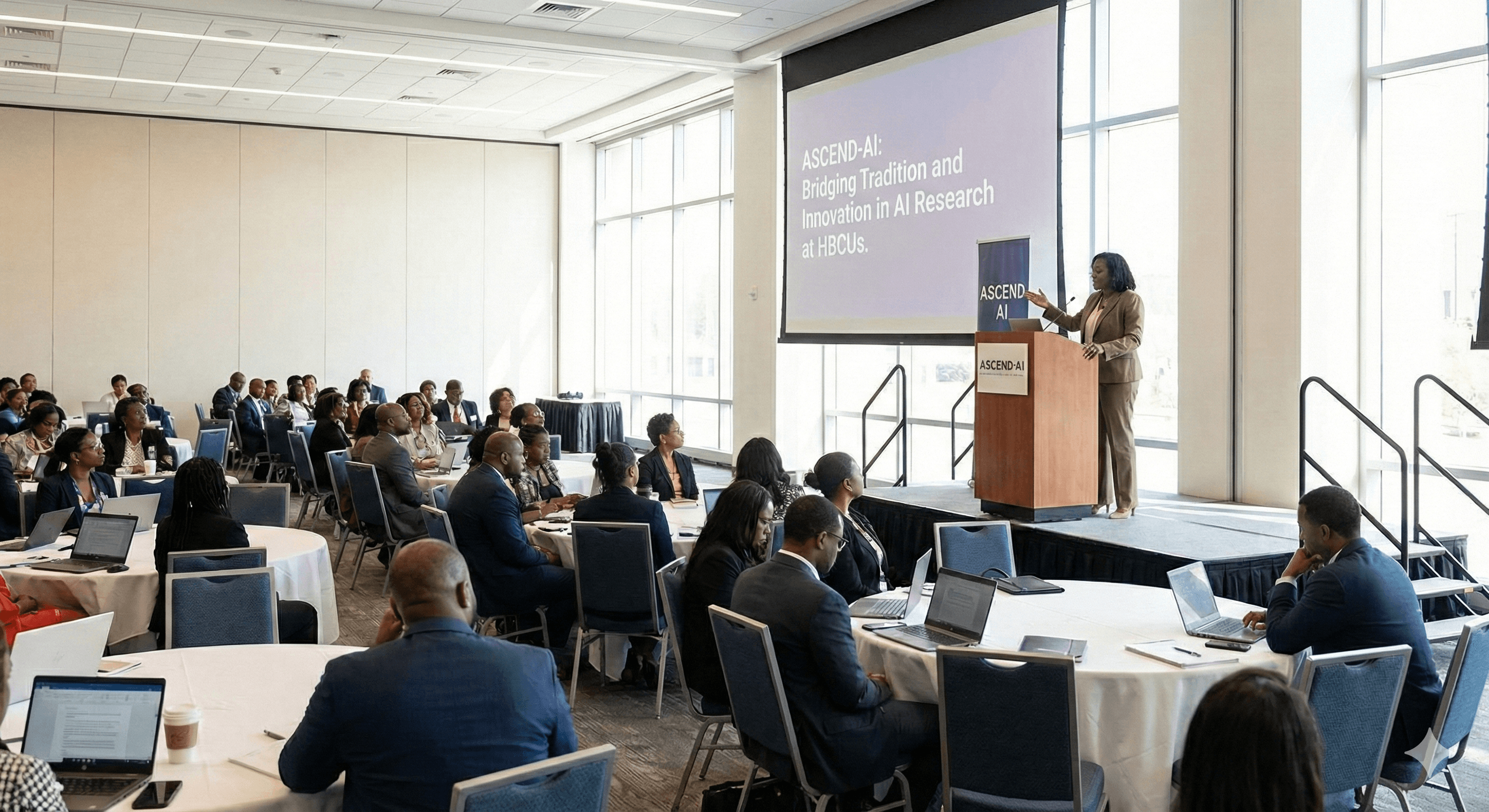
COAS AI SYMPOSIUM
Sponsored by the College of Arts and Sciences, Howard University. Featuring the Launch of ASCEND-AI
Learn more
© 2026 ASCEND-AI. A U.S. Department of Education FIPSE Initiative. Howard University, Lead Institution.
This project is supported by the U.S. Department of Education’s Fund for the Improvement of Postsecondary Education (FIPSE). The content of this website does not necessarily represent the policy of the Department of Education, and endorsement by the federal government should not be assumed.
© 2026 ASCEND-AI. A U.S. Department of Education FIPSE Initiative. Howard University, Lead Institution.
This project is supported by the U.S. Department of Education’s Fund for the Improvement of Postsecondary Education (FIPSE). The content of this website does not necessarily represent the policy of the Department of Education, and endorsement by the federal government should not be assumed.