ASCEND-AI’s Faculty Learning Communities (FLCs) serve as the primary vehicle for faculty development, employing a facilitative rather than lecture-based instructional model. Guided by the ‘Learner’s Arc: From Understanding to Innovation’ framework, participating faculty progress through iterative stages of developing their ‘AI identity’—building competency across mind (technical understanding), heart (ethical frameworks), soul (disciplinary integration), and courage (innovative application) components.
This approach prioritizes psychological safety and reflection-based assessment, ensuring that faculty engagement leads to genuine pedagogical transformation rather than surface-level tool adoption.
What are Faculty Learning Communities?
Faculty Learning Communities (FLCs) are groups of faculty from diverse disciplines who engage in sustained, collaborative exploration of teaching, learning, and scholarly practice. Unlike traditional professional development workshops that offer one-time training sessions, FLCs create year-long (or longer) spaces for ongoing dialogue, experimentation, reflection, and peer learning.
FLCs are grounded in communities of practice theory and constructivist learning principles, recognizing that meaningful professional development occurs through active engagement with new ideas, experimentation in authentic contexts, and reflection within supportive peer networks. Faculty learn not just from expert presentations but from each other's experiences, challenges, and innovations.
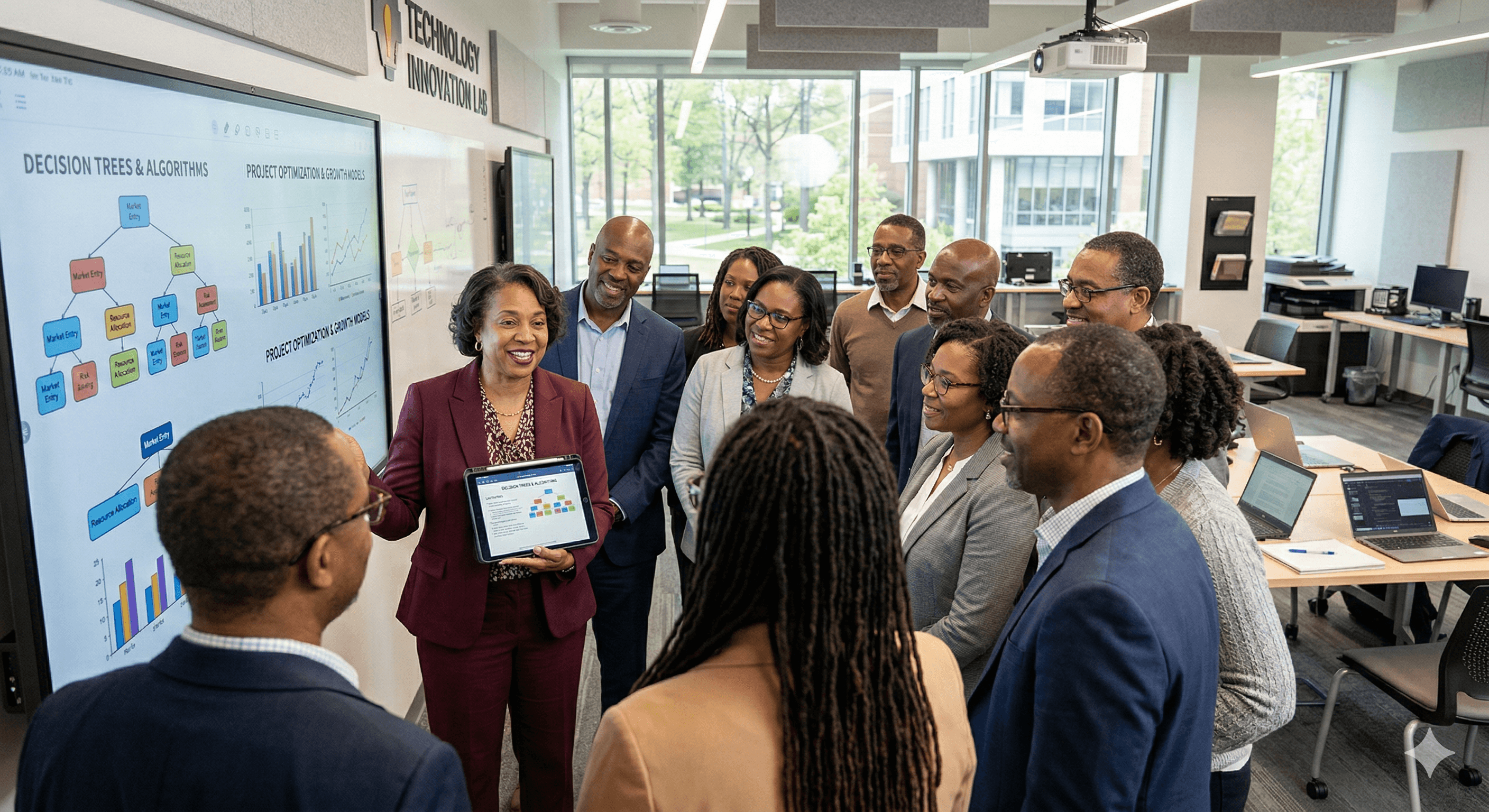
Meet the Faculty Learning Community (2026-2027)
Howard University
Investigates discipline-specific applications of AI in the humanities, social sciences, and natural sciences, exploring how emerging technologies can support teaching, research, critical inquiry, discovery, and responsible AI integration.
Bowie State University
Investigates discipline-specific applications of AI in business and health sciences, exploring how emerging technologies can enhance learning, research, professional practice, innovation, and workforce readiness.
Howard University
Facilitators
Subject Matter Experts
Tiffany Simmons, Ed.D., J.D.
Members
Portia Williams, Ph.D.
Bowie State University
Facilitators
Hamdan Alabsi, Ph.D.
Subject Matter Experts
Elkanah Faux, Ph.D.
Jeremy Treadwell, M.B.A.
Matthew Uzukwu, Ph.D.
Nicole Wilson, M.A.
Members
James Akwarand, Ph.D.
Amina Ayodeji-O, Ph.D.
Thaddee Badibang, Ph.D.
DeRonte Craig, MIE
Honore Haughton, M.S.
Kavita Kapur, Ph.D.
Richard Knight, M.B.A.
Nega Lakew, Ph.D.
Augustin Ntembe, Ph.D.
Sunando Sengupta, Ph.D.
Qingqing Sun, Ph.D.
Patrick Thomas, PhD.
FLC At A Glance
Bringing together faculty to explore, evaluate, and apply AI in their fields.
2
Partner Institutions
44
Participants
5
Facilitators
9
Subject Matter Experts
30
Faculty Fellows
15+
Disciplines Represented
FLC Participation Framework
Year-Long Commitment
Faculty commit to participating in monthly FLC sessions throughout the academic year, with biweekly summer opportunities for intensive curriculum development work. New cohorts join annually, creating expanding networks of AI literacy expertise across both institutions.
Five Module Focus Areas
FLC work is organized around ASCEND-AI's five programmatic areas: (1) foundational AI literacy, (2) responsible use and academic integrity, (3) detecting misinformation and hallucinations, (4) discipline-specific instruction, and (5) AI-driven entrepreneurship. Faculty engage deeply with each area while developing curriculum materials for implementation.
Curriculum Development Emphasis
Rather than passive learning, FLC participants actively create instructional materials, assessment tools, and assignment frameworks that can be adapted across disciplines. These materials become shared resources available to faculty beyond FLC participation.
Reciprocal Capacity Building
Howard and Bowie State faculty bring different institutional contexts, pedagogical traditions, and student populations. Cross-institutional dialogue strengthens both institutions' approaches while creating collaborative relationships that extend beyond the grant period.
Assessment and Evaluation
External evaluation by BrickRose Exchange tracks FLC effectiveness through faculty professional development outcomes, student learning gains in courses taught by FLC participants, and sustainability of AI literacy integration beyond the initiative.